


 PLATFORM UPDATE:

Theoretical investigation to predict physicochemical performances and evaluate comprehensive properties of a novel CL-20/LLM-116 cocrystal explosive: a molecular dynamics (MD) study
 *a
*a
Abstract
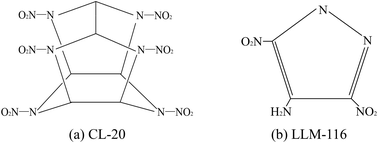
Cocrystallization technology is a successful application of supramolecular chemistry in improving the performance of materials. Besides, this technology is regarded as a promising and effective approach to tune the properties of energetic compounds, especially for high-energy-density materials. In this work, based on the high energy density and high mechanical sensitivity of the explosive 2,4,6,8,10,12-hexanitro-2,4,6,8,10,12-hexaazaisowurtzitane (CL-20), a cocrystallization method was put forward to decrease its sensitivity and enhance its safety. Based on this principle, a typical insensitive explosive, 4-amino-3,5-dinitro-pyrazole (LLM-116), was selected as a coformer, and a novel CL-20/LLM-116 energetic cocrystal was designed. The CL-20/LLM-116 cocrystal models with component ratios from 10 : 1 to 1 : 5 were established. The cocrystal models were optimized and the physicochemical performances were predicted by the molecular dynamics (MD) method. The results illustrate that among the different cocrystal models, the binding energy for the cocrystal model with a molar ratio of 2 : 1 is the highest at 640.42 kJ mol−1, the non-covalent interactions are strongest, and this model holds the most desirable stability. The insensitive component LLM-116 enhances the trigger bond rupture energy of CL-20 molecules by 2.6–22.4 kJ mol−1 compared to pure CL-20, meaning that the CL-20/LLM-116 energetic cocrystal is less sensitive than CL-20, and when the molar ratio is 2 : 1, the cocrystal model has the highest value of trigger bond strength. The designed CL-20/LLM-116 cocrystal exhibits lower energy density than pure CL-20, but it still maintains high energetic performance, especially for the cocrystal model with a molar ratio from 10 : 1 to 1 : 1. Its energy density is higher than those of octahydro-1,3,5,7-tetranitro-1,3,5,7-tetrazocine (HMX) and hexahydro-1,3,5-trinitro-1,3,5-triazine (RDX), implying that the CL-20/LLM-116 energetic cocrystals maintain a high energy density. The main intermolecular interactions existing in the CL-20/LLM-116 energetic cocrystals include hydrogen bonding and van der Waals (vdW) forces.
- This article is part of the themed collection: Supramolecular & Polymorphism
 Please wait while we load your content...


