


 PLATFORM UPDATE:


Non-monotonic metastable zone-width behavior in cooling cocrystallization: a case study on the sulfamethazine-acetylsalicylic acid cocrystal system
 a
and
Jose V.
Parambil
*a
a
and
Jose V.
Parambil
*a
Abstract
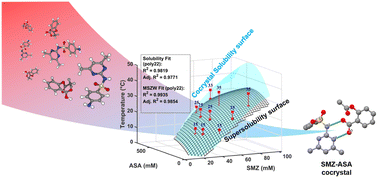
The metastable zone width (MSZW) during the cooling crystallization of sulfamethazine–acetylsalicylic acid (SMZ–ASA) cocrystal system in acetonitrile (ACN) exhibits different patterns with variations in coformer ratios and saturation temperatures. Studies were carried out at a fixed 0.3 °C min−1 cooling rate in 20 mL with three agitation rates (100, 400, and 800 RPM), across a saturation temperature range of 15–35 °C with ASA/SMZ molar ratios ranging from 2.5–9.61. Polynomial surface fitting of the induction time data was employed to assess the dependence of MSZW on solute concentration and saturation temperature, where the concentration range was varied between 30–70 mM for SMZ and 100–400 mM for ASA. The results revealed that both coformers' composition and temperature strongly influence MSZW. Importantly, a non-monotonic trend was observed, with the MSZW broadening at higher saturation temperatures for fixed ASA/SMZ ratios, an atypical behavior compared to conventional cooling crystallization. These findings emphasize the system-specific complexity of cocrystal nucleation and the intertwined influence of solute composition and saturation temperature.
- This article is part of the themed collection: Crystal Engineering Techniques
 Please wait while we load your content...


