


 PLATFORM UPDATE:


A kinetically informed thermodynamic (KIT) design framework for understanding the crystallization characteristics of resveratrol
 a
Zoltan K.
Nagy
*a
a
Zoltan K.
Nagy
*a
Abstract
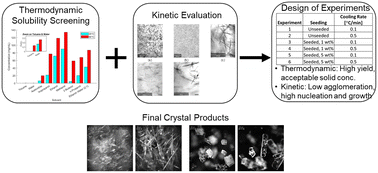
Crystallization is a crucial process in the production of solid materials across various industries, where it not only purifies the compound but also defines essential particle attributes. These particle-specific critical quality attributes (CQAs), including crystal size distribution, morphology, and purity, directly impact the quality and efficiency of downstream operations, such as filtration, drying, and formulation. The ability to precisely control these attributes during crystallization is essential for ensuring consistent product quality, process efficiency, and regulatory compliance. Many process parameters can influence CQAs; the solvent is often the first variable investigated when designing a crystallization process, and selection is typically guided by thermodynamic criteria such as solubility and theoretical yield. However, as development advances to larger scales, kinetic limitations such as agglomeration or poor crystal habit often emerge, driven by factors like local supersaturation, mixing inefficiencies, and particle–particle interactions. These behaviors are difficult to predict from solubility data alone and require experimental insight to effectively manage. This study presents a kinetically informed thermodynamic (KIT) design framework for solvent screening to help mitigate these issues. The KIT design framework enhances early decision-making by combining traditional thermodynamic screening with straightforward kinetic assessments using small-scale cooling crystallization experiments. Through qualitative observations of nucleation, growth, agglomeration, and aspect ratio, the framework helps prioritize solvents that not only meet yield targets but also support desirable kinetic behavior. This integrated approach improves the reliability of solvent selection, reduces the likelihood of scale-up challenges, and minimizes the need for extensive late-stage process troubleshooting.
 Please wait while we load your content...


