


 PLATFORM UPDATE:


Link between graphene features and the resulting functionality of quasi-van der Waals Zn3P2
 a
Nico
Kawashima,
de
Raphael
Lemerle,
a
Silvana
Botti,
de
Maria Chiara
Spadaro,
bf
Valerio
Piazza,
a
Jordi
Arbiol
bg
and
Anna
Fontcuberta i Morral
*a
a
Nico
Kawashima,
de
Raphael
Lemerle,
a
Silvana
Botti,
de
Maria Chiara
Spadaro,
bf
Valerio
Piazza,
a
Jordi
Arbiol
bg
and
Anna
Fontcuberta i Morral
*a
Abstract
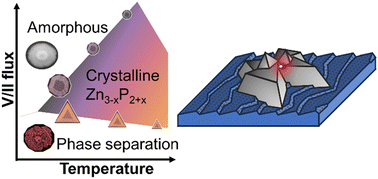
Zn3P2, made from earth-abundant elements, is a promising candidate for thin-film solar cells but faces limitations due to difficulties in achieving n-type doping and its large lattice mismatch with commercial substrates and a high thermal expansion coefficient, causing defects and cracks. Graphene substrates can address these challenges thanks to its weak van der Waals interactions with Zn3P2 allowing for mechanical transfer of the thin film and strain-free growth. This study compares five graphene substrates for quasi-van der Waals epitaxial (q-vdWe) growth of polycrystalline Zn3P2 thin films using molecular beam epitaxy. Surface features like steps and wrinkles on graphene were identified as main nucleation sites for Zn3P2, provided the graphene has minimal point defects. The highest-quality thin films, with the largest grain sizes, were grown on H-CVD graphene on the Si-face of 6H-SiC, featuring solely terraces of atomic height. All substrates showed comparable growth windows for crystalline Zn3P2, with higher growth temperatures improving crystal quality, as indicated by enhanced photoluminescence. Cryo-cathodoluminescence measurements revealed spatially localized sub-bandgap emissions, potentially linked to localized strain fields at grain boundaries of up to ±3% as identified by cross-sectional transmission electron microscopy. This work provides insights into advantages and drawbacks of utilising q-vdWe to produce Zn3P2 thin films for solar cell applications and highlights the effects of graphene substrate choice and growth parameters on Zn3P2 film quality.
- This article is part of the themed collections: Articles behind the 2026 journal covers and Crystal Growth
 Please wait while we load your content...


