


 PLATFORM UPDATE:


The direct methanol circular fuel cell: an electrocatalyst design perspective on selective CO2 recycling

Abstract
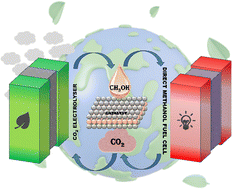
Direct methanol fuel cells (DMFCs) have emerged as a promising energy conversion platform amid the growing energy demand, particularly for portable and low-power applications, owing to their high energy density and low-temperature operation. However, CO2 evolution from the anodic exhaust during DMFC operation poses a challenge in achieving carbon neutrality. The selective electrochemical conversion of CO2 to methanol offers an efficient strategy for establishing a recyclable, carbon-neutral DMFC. This review presents the latest developments in electrocatalysts for DMFCs, namely, the anodic methanol oxidation reaction (MOR), the cathodic oxygen reduction reaction (ORR), and the selective electrochemical reduction of CO2 to methanol. We highlight recent advances in catalyst design driven by a mechanistic, molecular-level understanding of intermediate stabilisation to achieve methanol selectivity, including significant advances in phthalocyanine-, copper-, non-copper-, MOF-, and other emerging complex systems. In addition, a perspective on achieving a closed-carbon-loop, carbon-neutral DMFC is presented by integrating a CO2 electrolyser with a methanol-selective electrocatalyst and a DMFC stack, offering a pathway toward sustainable, scalable energy systems.
- This article is part of the themed collection: ChemComm Electrocatalysis
 Please wait while we load your content...


