


 PLATFORM UPDATE:


Discovering new materials knowledge from “old data”

Abstract
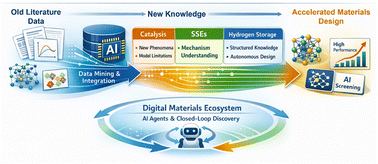
From “old data” to new knowledge discovery, this paradigm is fundamentally reshaping research in chemistry and materials. Unlike traditional trial-and-error approaches, knowledge mining driven by large-scale databases offers unprecedented potential in exploring complex compositional spaces and accelerating rational materials design. In this review, we highlight three significant progresses in discovering new materials knowledge from “old literature data”: (1) In the field of catalysis, data-driven approaches reveal new phenomena and limitations of existing theoretical models, greatly accelerating materials design and screening. (2) In the field of solid-state electrolytes, data empowerment accelerates the understanding of underlying physical mechanisms. (3) In the field of hydrogen storage, we demonstrate a pathway from “old data” to structured knowledge and finally to autonomous design. Finally, we highlight the critical role of database construction in data intelligence and the development of AI agents for materials design. Looking ahead, such data-driven models will continue to deepen our knowledge generation and accelerate the discovery of target materials in the relevant field. By integrating knowledge generation from “old data”, theoretical simulations, and experimental validation, this approach promises to establish a digital materials ecosystem for cross-disciplinary innovation, where materials discovery will be continuously accelerated.
 Please wait while we load your content...


