Constant-Potential DFT Insights into CO₂ Electroreduction on Fe3 and Cu3 Clusters Supported by N-Doped Graphene
Abstract
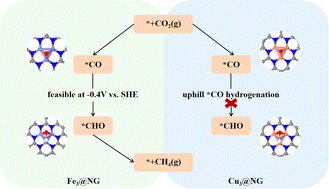
Constant-potential DFT reveals distinct CO₂ reduction behavior onFe₃ and Cu₃ clusters supported on N-doped graphene. Fe₃@NG enables deep reduction toward CH₄ at mild cathodic bias, whereas Cu₃@NG remains limited by uphill *CO hydrogenation. This contrast originates from Fe-induced electronic modulation that promotes CO₂-derived intermediate activation.Electrocatalytic CO₂ reduction reaction (CO₂RR) offers a promising route for converting CO₂ into value-added chemicals using renewable electricity under mild conditions. 1-3 However, its practical implementation remains challenging because the high thermodynamic stability of CO₂, the complexity of multielectron/proton transfer pathways, and the competing hydrogen evolution reaction (HER) together hinder both activity and product selectivity. [4][5][6] Developing electrocatalysts that can efficiently activate CO₂ while steering reaction pathways toward desired products is therefore central to advancing CO₂RR.Single-atom catalysts (SACs) have attracted extensive interest in CO₂RR due to their high atomic utilization and well-defined active sites. [7][8][9][10] Extending this concept from isolated atoms to atomically precise clusters offers additional opportunities to tune local geometry, metal-metal cooperation, and electronic structure while retaining high metal efficiency. [11][12][13] In particular, triatomic clusters have recently emerged as promising CO₂RR motifs, showing enhanced activity and product tunability across different supports and metal compositions. [14][15][16][17][18] However, most theoretical studies on such systems still rely on the conventional computational hydrogen electrode (CHE) framework, which cannot explicitly capture the electrode-potential-dependent evolution of electronic states and adsorbate thermodynamics. [19][20][21] This limitation is particularly critical for small cluster catalysts, whose reactivity is highly sensitive to charging and interfacial electric fields.
- This article is part of the themed collection: ChemComm Electrocatalysis
Please wait while we load your content...