


 PLATFORM UPDATE:


Chemistry in evaporating sessile droplets
 a
and
Arun
Chattopadhyay
*ab
a
and
Arun
Chattopadhyay
*ab
Abstract
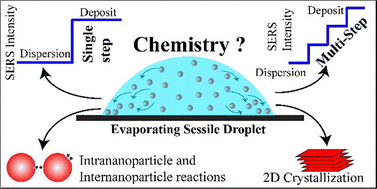
Sessile droplet evaporation is a fundamental natural process that plays an important role in inkjet printing-based two-dimensional (2D) thin-film fabrication. The deposit kinetics and the nature of the deposition of microparticles are well-known; however, studies on nanoparticle-laden droplet evaporation have only recently been reported by our laboratory. The unique chemical phenomena associated with evaporating droplets need special attention in order to harness the potential of their applications. Apart from the physical phenomena of fluid dynamics and nanoparticle movement, understanding the chemistry on the surface of nanoparticles and chemical interactions between nanoparticles and solvent in the deposits is of great importance. In our investigations, we have used surface-enhanced Raman spectroscopy to monitor the deposition of chemically functionalized nanoparticles, chemical interactions, and reactions on the surface of deposited nanoparticles at the three-phase contact line. This review highlights the discovery of single-phase transitions in the deposition of plasmonic nanoparticles of different sizes and initial concentrations, as opposed to the well-known gradual deposition of microparticles. Importantly, the study led to the distinction between intrananoparticle and internanoparticle plasmon-catalyzed reactions. The effect of the pH of the medium on the transition from single to multiple steps of deposition of nanoparticles and their distribution across the annulus of the ring deposit constitutes important observations in this regard. A salient feature is the observation of anomalous 2D crystal formation upon evaporation of droplets of molecular solutions. Finally, this article concludes by discussing the potential of the newly discovered chemistry of nanoparticle deposition for future research in liquid-based printing and 2D moiré superlattices.
- This article is part of the themed collection: Advances in Low-Dimensional Materials for Optoelectronic Devices, Energy Catalysis, and Storage
 Please wait while we load your content...


