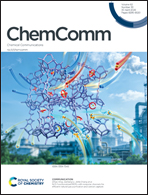
Molecularly anchoring TPE-PDMS micro-dots for rupture-free and high-fidelity deformation mapping

Abstract

We report a molecular grafting strategy to eliminate interfacial rupture in stretchable sensors. By synthesizing tetraphenylethylene-polydimethylsiloxane (TPE-PDMS) copolymers, the sensing dots achieve seamless integration and synchronized co-deformation with substrates via enhanced molecular compatibility. This robust interface ensures high-fidelity strain mapping and reliable fracture warning, maintaining performance over 1,000 cycles.

Supplementary files

Article information

Article type
Communication
Submitted
17 Feb 2026
Accepted
23 Mar 2026
First published
09 Apr 2026

Chem. Commun., 2026, Accepted Manuscript

Molecularly anchoring TPE-PDMS micro-dots for rupture-free and high-fidelity deformation mapping

W. Wang, Z. Zhao, X. Sun, L. Xu, Z. Wang, X. Jiang and S. Wang, Chem. Commun., 2026, Accepted Manuscript , DOI: 10.1039/D6CC01041E

To request permission to reproduce material from this article, please go to the Copyright Clearance Center request page.

If you are an author contributing to an RSC publication, you do not need to request permission provided correct acknowledgement is given.

If you are the author of this article, you do not need to request permission to reproduce figures and diagrams provided correct acknowledgement is given. If you want to reproduce the whole article in a third-party publication (excluding your thesis/dissertation for which permission is not required) please go to the Copyright Clearance Center request page.

Read more about how to correctly acknowledge RSC content.

Social activity

Spotlight

Advertisements