Multiplexed Self-Powered Biosensor for Ultrasensitive On-Site Detection of Trace Cisplatin via Catalytic Repurposing

Abstract

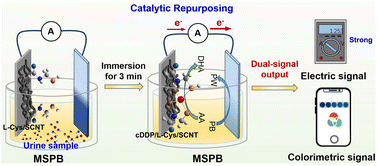
We develop a multiplexed self-powered cisplatin sensor based on catalytic repurposing. Cisplatin is reengineered as a catalyst, amplifying dual-output signals of electrical and smartphone-readable colorimetric outputs. Sensitivity increases 1,000-fold with a broad range (200 nM–100 μM). Dual-output cross-validation yields results matching ICP-MS. This provides a field-deployable platform for precise drug monitoring.

Supplementary files

Transparent peer review

To support increased transparency, we offer authors the option to publish the peer review history alongside their article.

View this article’s peer review history

Article information

Article type
Communication
Submitted
13 Feb 2026
Accepted
08 Apr 2026
First published
09 Apr 2026

Chem. Commun., 2026, Accepted Manuscript

Multiplexed Self-Powered Biosensor for Ultrasensitive On-Site Detection of Trace Cisplatin via Catalytic Repurposing

L. Wang, M. Jing, D. Lu, Y. Wang, M. Luo, G. Chen and Q. Min, Chem. Commun., 2026, Accepted Manuscript , DOI: 10.1039/D6CC00966B

To request permission to reproduce material from this article, please go to the Copyright Clearance Center request page.

If you are an author contributing to an RSC publication, you do not need to request permission provided correct acknowledgement is given.

If you are the author of this article, you do not need to request permission to reproduce figures and diagrams provided correct acknowledgement is given. If you want to reproduce the whole article in a third-party publication (excluding your thesis/dissertation for which permission is not required) please go to the Copyright Clearance Center request page.

Read more about how to correctly acknowledge RSC content.

Social activity

Spotlight

Advertisements