Photocatalyzed Generation of Acyl Radicals from Aryl/Alkyl Acyl Halides via Nucleophilic Substitution

Abstract

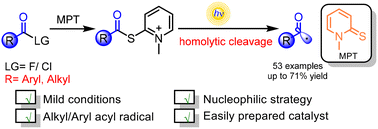
Herein, we introduce a nucleophilic catalysis strategy based on 1methylpyridine-2(1H)-thione (MPT) catalyst, which mediates the in-situ generation of photoactive intermediates from various acyl halides. This strategy enables efficient formation of both aryl and alkyl acyl radicals upon visible-light irradiation, including those derived from otherwise unreactive alkyl acyl fluorides/chlorides.Acyl halides are inexpensive, abundant, highly reactive, and commercially available chemicals that have been extensively employed in organic synthesis, 1, 2 traditionally engaging in transformations via acyl cation intermediates. Concurrently, visible-light photoredox catalysis has emerged as a powerful, sustainable, and environmentally benign synthetic strategy. [3][4][5] This strategy has unlocked diverse acyl radical precursors, including ketoacids, aldehydes, and notably, acyl chlorides, thereby significantly expanding the synthetic toolbox for radical acylation reactions with high synthetic potential.Through the photooxidative pathways, ketoacids have been established as versatile aryl and alkyl acyl sources, enabling efficient construction of C-C 6-9 and C-X 10 bonds. Aldehydes are also used as acyl radical sources via photoinduced hydrogen atom transfer process, participating in radical addition reactions 11,12 , coupling reactions 13 and functional group conversion reactions 14,15 . Through the photoreductive pathway, acid anhydride 16 and acid chloride [17][18][19][20] have been utilized for acyl radical generation, though the latter have been limited to aryl acid chlorides. Additional methods, such as the phosphorus-mediated deoxygenation of carboxylic acids [21][22][23] , along with thioester [24][25][26] and acyl silanes 27 , further complement the toolbox for acyl radical generation.However, the photocatalytic application of carboxylic acid derivatives, particularly alkyl acyl halides and acid anhydrides, remains constrained by redox potential limitations 28-30 (Scheme 1a). For instance, acetyl chloride (E1/2 red = -1.98 V 29 vs SCE.) and c) MPT catalyzed acyl radical formation via nucleophilic substitution (this work)

Supplementary files

Article information

Article type
Communication
Submitted
02 Feb 2026
Accepted
09 Mar 2026
First published
10 Mar 2026
This article is Open Access
Creative Commons BY-NC license

Chem. Commun., 2026, Accepted Manuscript

Photocatalyzed Generation of Acyl Radicals from Aryl/Alkyl Acyl Halides via Nucleophilic Substitution

H. Zhan, J. Chen, Y. Luo, Y. Ke and X. Tang, Chem. Commun., 2026, Accepted Manuscript , DOI: 10.1039/D6CC00687F

This article is licensed under a Creative Commons Attribution-NonCommercial 3.0 Unported Licence. You can use material from this article in other publications, without requesting further permission from the RSC, provided that the correct acknowledgement is given and it is not used for commercial purposes.

To request permission to reproduce material from this article in a commercial publication, please go to the Copyright Clearance Center request page.

If you are an author contributing to an RSC publication, you do not need to request permission provided correct acknowledgement is given.

If you are the author of this article, you do not need to request permission to reproduce figures and diagrams provided correct acknowledgement is given. If you want to reproduce the whole article in a third-party commercial publication (excluding your thesis/dissertation for which permission is not required) please go to the Copyright Clearance Center request page.

Read more about how to correctly acknowledge RSC content.

Social activity

Spotlight

Advertisements