


 PLATFORM UPDATE:


Synthetic fluorescent receptor arrays for sensing in complex matrices: from robust chemistry to data-driven readouts

Abstract
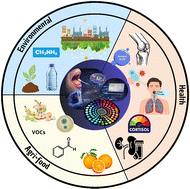
Sensing is moving from specific lock-and-key biorecognition toward chemically programmable, pattern-based approaches. Synthetic fluorescent receptor arrays, composed of rationally designed organic probes (e.g., rhodamines, BODIPYs, naphthalimides, and carbon dots) that engage analytes through non-covalent interactions, offer a robust and versatile platform for multidimensional detection. Rather than relying on a single high-affinity interaction, these arrays exploit highly selective responses across many probes. Multivariate analysis (PCA/PLS/PLS-DA) or modern machine learning converts the complex optical pattern into identity and concentration. This Feature Article highlights that chemical stability, operational versatility, and compatibility with unprocessed, real samples are the decisive advantages of synthetic arrays over classical biosensing. Synthetic receptors tolerate wider pH/ionic strength/solvent windows, resist denaturation, support long shelf-life, and can be mass-produced with consistent performance. Their modularity enables coverage from gases/VOCs to small metabolites and biomarkers, while their signal transduction (fluorescence/colorimetry) integrates seamlessly with smartphone cameras (fieldable readout), optical fibers (real-time, in situ monitoring), and hyperspectral imaging (spatially resolved analytics). These attributes open opportunities in food safety, environmental surveillance, and point-of-care diagnostics where pretreatment is impractical. In addition, pre-analytical handling (centrifugation, filtration, and storage) reshapes sample composition and erodes both qualitative identities and quantitative readouts. This Feature Article emphasizes that analyzing as-collected specimens preserves the native chemical fingerprint that cross-reactive arrays exploit. We outline practical designs and drift-aware workflows that enable minimal handling while maintaining selectivity, sensitivity, and wide linear ranges in complex matrices. A review of selected recent case studies applied to human health, environmental, and agri-food fields demonstrates the approach: ppb or pM limits of detection, minute-scale analyses, and multi-decade linear ranges (up to nine orders) with reliable performance in untreated matrices such as saliva, fruit headspace, environmental waters, and simulated synovial fluid.
 Please wait while we load your content...


