Molecular Engineering of Excited-State Dynamics via ICT toward a Cross-Reactive Single-Fluorophore Array for Discriminative Sensing of VOCs

Abstract

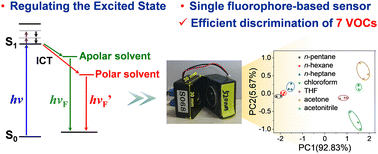
The development of high-performance fluorescent film-based sensors (FFSs) for on-site, real-time detection requires fluorescent units that overcome the limitations of conventional materials, such as aggregation-caused quenching (ACQ) and poor photostability. Herein, we report a novel donor–acceptor fluorophore (BDP1) engineered with high microenvironmental polarity sensitivity via an intramolecular charge-transfer (ICT) mechanism. The derived nanostructured co-assembled film (BDP1/C1) integrates three critical attributes for practical volatile organic compound (VOC) sensing: (i) exceptional photochemical stability, preventing photobleaching during repeated use; (ii) pronounced polarity sensitivity, enabling fast and reversible analyte detection; and (iii) a single-fluorophore-based sensing platform that simplifies device design and discriminates seven distinct VOCs through pattern recognition. This work establishes BDP1/C1 as a robust and responsive optical sensing material, demonstrating a strategic advance toward miniaturized, high-performance FFSs.

Supplementary files

Article information

Article type
Communication
Submitted
31 Jan 2026
Accepted
02 Mar 2026
First published
03 Mar 2026

Chem. Commun., 2026, Accepted Manuscript

Molecular Engineering of Excited-State Dynamics via ICT toward a Cross-Reactive Single-Fluorophore Array for Discriminative Sensing of VOCs

N. An, L. Zhang, Z. Yin, M. Xing, Y. Xue, R. Wen, J. Yan, J. Liu and Y. Fang, Chem. Commun., 2026, Accepted Manuscript , DOI: 10.1039/D6CC00672H

To request permission to reproduce material from this article, please go to the Copyright Clearance Center request page.

If you are an author contributing to an RSC publication, you do not need to request permission provided correct acknowledgement is given.

If you are the author of this article, you do not need to request permission to reproduce figures and diagrams provided correct acknowledgement is given. If you want to reproduce the whole article in a third-party publication (excluding your thesis/dissertation for which permission is not required) please go to the Copyright Clearance Center request page.

Read more about how to correctly acknowledge RSC content.

Social activity

Spotlight

Advertisements