


 PLATFORM UPDATE:


Research advances in covalent labeling for fluorescence imaging of proteins
 a
Guang
Chen
*a
a
Guang
Chen
*a
Abstract
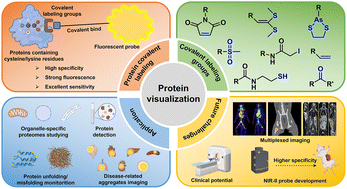
Proteins are crucial life components, to precisely detect and visualize them is vital for understanding their biological functions and disease mechanisms. This review aims to demonstrate an overview of the development and further prospects of covalently labeling fluorescent probes for protein studies. These fluorescent probes can stably bind to specific residues and have become vital tools for tracking proteins over time due to their high specificity, strong signals, and excellent sensitivity. This review summarizes recent progress in the design, mechanisms, and biological uses of these probes over the past few decades. According to the labeling functional groups (including maleimides, carbon–carbon double bonds, halogens, sulfhydryl/sulfonyl groups, arsenic(III), and aldehydes/ketones), representative examples are categorized and their applications in protein detection, protein unfolding/misfolding monitoring, disease related aggregate imaging, and organelle specific proteome studies are discussed. Future directions and challenges, such as NIR-II probe development, higher specificity, multiplexed imaging, and clinical potential, are discussed to support researchers across chemistry, biology, and medicine in developing improved fluorescence tools for protein research.
 Please wait while we load your content...


