


 PLATFORM UPDATE:


Peptide–protein docking: from physics-based models to generative intelligence

Abstract
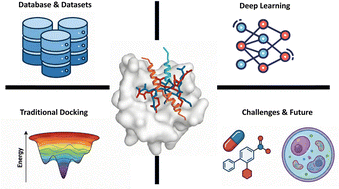
Peptide–protein interactions (PepPIs) play a pivotal role in cellular signaling and regulation, representing a significant category of therapeutic agents. However, determining peptide–protein complex structures by experiment is costly and often challenging. Computational peptide–protein complex structure prediction, therefore, plays an important role in mapping binding modes and guiding design. Classical pipelines combine template-based, local, or global docking conformational search algorithms with physics-based or empirical scoring, but they often struggle with highly flexible peptides, induced fit at shallow interfaces, and non-canonical chemistries. In this review, we describe an ongoing shift from such conventional search-and-score workflows to deep learning-based pipelines. We categorize the modern methods into three modules: (i) approaches that predict likely peptide-binding regions on the protein surface and use these predictions to guide or filter docking models; (ii) AlphaFold-based protocols that use general structure prediction methods for peptide–protein co-folding and refinement; and (iii) deep generative models that sample peptide conformations given a target protein structure. We highlight that recent methods have substantially improved the accuracy and applicability of peptide–protein docking, while also identifying shared remaining challenges, including limited avaiability of training data and weak performance on long, disordered, or chemically modified peptides. We conclude by outlining directions for integrating richer biophysical constraints, better-curated peptide–protein datasets, and large-scale generative models to move toward robust, design-ready peptide docking.
- This article is part of the themed collection: Advances in Computational Protein Design, Structural Biology, and Drug Discovery
 Please wait while we load your content...


