


 PLATFORM UPDATE:

Amorphization and defect engineering of Nb2O5 within a graphitic nanocage array for catalytic polysulfide conversion in lithium–sulfur batteries
 a
Angang
Dong
*b
a
Angang
Dong
*b
Abstract
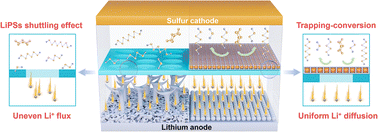
Lithium–sulfur batteries (LSBs) are limited by lithium polysulfide (LiPS) shuttling and sluggish redox kinetics. To address this challenge, we design an amorphous, oxygen-deficient Nb2O5 embedded in a mesoporous graphitic framework (Nb2O5@MGF) as a multifunctional interlayer that strongly traps and catalytically converts LiPS. The Nb2O5@MGF uniformizes the sulfur distribution, exposes vast active interfaces, and offers a reduced ion/electron transportation pathway for expedited redox reaction. Moreover, the amorphous Nb2O5 manipulates LiPS chemical affinity, while oxygen vacancies improve catalytic activity. Consequently, the Nb2O5@MGF-equipped cell exhibits high capacity and stable cycling. This work presents a synergistic crystallinity and defect-engineering strategy for practical LSBs.
 Please wait while we load your content...


