A Single Heteroatom Controls Halogen-versus Chalcogen-Bond-Driven Cellular Uptake

Abstract

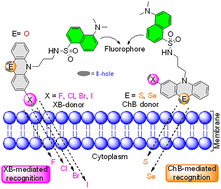
Halogen and chalcogen bonds can both promote membrane recognition, but how they compete within the same scaffold remains unclear. Here we develop a modular set of fluorescent probes in which a single heteroatom (O/S/Se) and a 2-halogen substituent (F–I) systematically alters the cell permeability. The oxygen analogues exhibit strongly halogen-dependent uptake consistent with halogen-bond-driven recognition, whereas sulfur and selenium analogues are internalized predominantly via chalcogen-bonding with minimal dependence on the halogen.

Supplementary files

Article information

Article type
Communication
Submitted
21 Jan 2026
Accepted
27 Feb 2026
First published
27 Feb 2026

Chem. Commun., 2026, Accepted Manuscript

A Single Heteroatom Controls Halogen-versus Chalcogen-Bond-Driven Cellular Uptake

D. Giri, E. Chauhan and G. Mugesh, Chem. Commun., 2026, Accepted Manuscript , DOI: 10.1039/D6CC00396F

To request permission to reproduce material from this article, please go to the Copyright Clearance Center request page.

If you are an author contributing to an RSC publication, you do not need to request permission provided correct acknowledgement is given.

If you are the author of this article, you do not need to request permission to reproduce figures and diagrams provided correct acknowledgement is given. If you want to reproduce the whole article in a third-party publication (excluding your thesis/dissertation for which permission is not required) please go to the Copyright Clearance Center request page.

Read more about how to correctly acknowledge RSC content.

Social activity

Spotlight

Advertisements