


 PLATFORM UPDATE:


Emerging two-dimensional materials for aqueous zinc-ion battery cathodes: progress and prospects
 *a
and
Youcun
Bai
*a
*a
and
Youcun
Bai
*a
Abstract
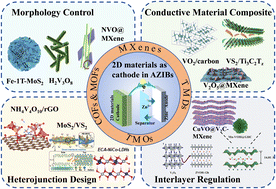
Aqueous zinc-ion batteries (AZIBs) hold great promise for applications in wearable devices, consumer electronics, and electric vehicles due to their high safety, low cost, and multi-electron transfer characteristics. However, existing cathode materials for AZIBs suffer from low electronic and zinc-ion conductivity, as well as complex energy storage mechanisms. Therefore, it is crucial to develop a structurally stable, high-capacity cathode material that is well-suited for AZIBs. Two-dimensional (2D) materials have garnered significant attention due to their unique layered structure, which is held together by weak van der Waals forces, making them ideal hosts for Zn2+ intercalation/deintercalation. This review establishes a quantifiable “structure–mechanism–performance” closed-loop framework from the perspective of 2D materials and proposes universal modification strategies to overcome the poor conductivity and capacity bottlenecks of AZIBs. It further identifies three critical bottlenecks hindering the practical deployment and scale-up of 2D materials in AZIBs, and presents an integrated solution roadmap aimed at bridging the gap between laboratory-scale innovation and industrial production.
 Please wait while we load your content...


