


 PLATFORM UPDATE:


Electrochemical C–N coupling: a review of mechanistic pathways and computational frameworks
 *abc
*abc
Abstract
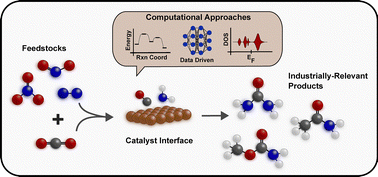
Electrochemical C–N coupling has emerged as a promising strategy for the sustainable synthesis of value-added chemicals derived from carbon- and nitrogen-containing feedstocks, such as CO2, NO3−, NO2− and N2. Despite progress in the field, the selective formation of C–N bonds remains challenging due to the need for the simultaneous activation of both reactants while suppressing the competing reaction pathways. Recent computational advances, including periodic density functional theory, grand-canonical and constant-potential methods, and data-driven catalyst screening, have enabled improved mechanistic insights. These computational approaches have allowed the rational design of catalysts capable of co-stabilising the carbon and nitrogen intermediates and promoting preferential C–N coupling over competitive product formation. This review will highlight the current understanding of the mechanistic and computational methods that drive the current discovery of the catalysts capable of efficient electrochemical C–N coupling.
- This article is part of the themed collection: ChemComm Electrocatalysis
 Please wait while we load your content...


