


 PLATFORM UPDATE:

Coordination-driven supramolecular metalla-cycles/cages for next-generation antibacterial therapy
 *be
and
Lin
Xu
*bf
*be
and
Lin
Xu
*bf
Abstract
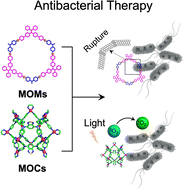
Bacterial resistance has become a critical global health threat, demanding innovative non-antibiotic strategies. Coordination-driven self-assembly provides a powerful approach for constructing metal–organic macrocycles and cages (MOMs/MOCs) with precisely defined cavities, tunable charge distributions, and multifunctional surfaces. These supramolecular architectures exhibit potent antibacterial activity through dual mechanisms: (i) electrostatic and hydrophobic disruption of bacterial membranes and (ii) photo-induced generation of reactive oxygen species (ROS) and localized heat for photothermal therapy. Recent advances demonstrate that integrating bimetallic centers, π-conjugated chromophores, and peptide or polymer functionalization enhances bacterial targeting, light utilization, and biocompatibility. Moreover, the incorporating of MOMs/MOCs into hydrogels and polymer networks enables sustained ROS release and mechanical stability, broadening their applicability in antibacterial wound dressings. This review summarizes recent progress in the design principles, mechanisms, and biomedical applications of MOMs/MOCs-based antibacterial systems, highlighting their potential as next-generation supramolecular therapeutics against multidrug-resistant pathogens.
- This article is part of the themed collection: Photodynamic Therapy (PDT)
 Please wait while we load your content...


