


 PLATFORM UPDATE:


Promoting reactant accumulation at solid–liquid interfaces through microstrain–defect engineering in overall water splitting

Abstract
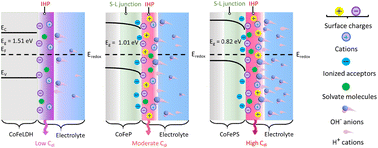
Herein, microstrain-engineered CoFePS derived from CoFeLDH enhanced the solid–liquid interface, improved ion diffusion and Cdl, and delivered 1.44 V at 10 mA cm−² with over 200 h stability for efficient water electrolysis.
- This article is part of the themed collection: ChemComm Electrocatalysis
 Please wait while we load your content...


