Zn(ii)-coordinated organic small molecule as a chiral fluorescent probe for discrimination and detection of tyrosine enantiomers

Abstract

Clamp-shaped chiral organic small molecules (COSM) are designed by linking one (1R,2R)-(+)-1,2-diphenyl-1,2-ethylenediamine molecule and two 5-methylsalicylic acid molecules via an amidation reaction. Aldehyde groups are introduced at positions ortho to the hydroxyl groups in the two 5-methylsalicylic acid units of the COSM via a Duff reaction. The COSM is then coordinated with Zn(II) to enhance its rigidity and strengthen its chirality. Imine bonds can be formed between the amino groups of tyrosine (Tyr) and the aldehyde groups of the COSM via a Schiff base reaction. These imine bonds play an important role in enhancing intramolecular charge transfer (ICT). Therefore, the Zn(II)-coordinated COSM can be used as a chiral fluorescent probe for discrimination and detection of Tyr enantiomers, and the limits of detection are 2.77 and 3.35 µM for D-Tyr and L-Tyr, respectively.
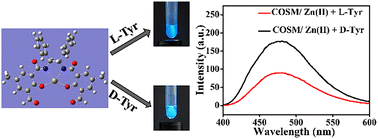
Graphical abstract: Zn(ii)-coordinated organic small molecule as a chiral fluorescent probe for discrimination and detection of tyrosine enantiomers

Supplementary files

Article information

Article type
Communication
Submitted
20 Dec 2025
Accepted
29 Jan 2026
First published
30 Jan 2026

Chem. Commun., 2026, Advance Article

Zn(II)-coordinated organic small molecule as a chiral fluorescent probe for discrimination and detection of tyrosine enantiomers

S. Li, J. Li, D. Wu, W. Cai, Z. Yin and Y. Kong, Chem. Commun., 2026, Advance Article , DOI: 10.1039/D5CC07249B

To request permission to reproduce material from this article, please go to the Copyright Clearance Center request page.

If you are an author contributing to an RSC publication, you do not need to request permission provided correct acknowledgement is given.

If you are the author of this article, you do not need to request permission to reproduce figures and diagrams provided correct acknowledgement is given. If you want to reproduce the whole article in a third-party publication (excluding your thesis/dissertation for which permission is not required) please go to the Copyright Clearance Center request page.

Read more about how to correctly acknowledge RSC content.

Social activity

Spotlight

Advertisements