


 PLATFORM UPDATE:


Degradation and interfacial chemistry of inorganic cathodes for potassium-ion batteries
 *a
and
Shaozhou
Li
*a
*a
and
Shaozhou
Li
*a
Abstract
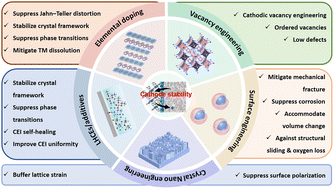
Potassium-ion batteries (KIBs) have emerged as promising, cost-effective alternatives to lithium-ion batteries. However, their practical viability is still hampered by persistent instabilities associated with cathode materials and their interactions with electrolytes. This review provides a mechanism-focused perspective on this challenge. We begin by summarizing the principal families of inorganic cathode materials with their corresponding electrolyte systems. Then, three coupled degradation mechanisms are highlighted: (i) lattice distortion and irreversible phase transitions arising from the large ionic radius of K+, (ii) oxygen release and transition-metal (TM) dissolution that accelerate electrolyte decomposition, and (iii) the dynamic formation, reconstruction, and failure of the cathode–electrolyte interphase (CEI). Recent progress in optimization strategies, including defect engineering (aliovalent doping and vacancy regulation), surface engineering, nano engineering, and electrolyte engineering, is critically evaluated with respect to their ability to suppress structural degradation, limit TM loss, and engineer robust CEIs. Finally, we discuss future directions, emphasizing the need for integrated approaches that combine theory and rational electrolyte design to achieve a durable CEI and crystal stability of the desired inorganic cathode material, in turn, leading to predictive control over long-term electrochemical behavior.
 Please wait while we load your content...


