


 PLATFORM UPDATE:


Achieving efficient and robust seawater oxidation through rational design of V2O3/NiFeP composite
 *be
*be
Abstract
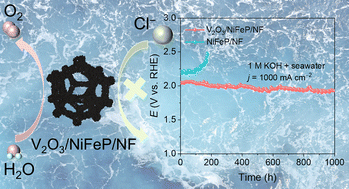
Direct seawater electrolysis has potential in green hydrogen production; however, its anode is susceptible to chloride-induced corrosion, limiting its durability. Herein, using nickel foam (NF) as a catalyst support, we developed a V2O3/NiFeP/NF anode for alkaline seawater oxidation. During the oxygen evolution reaction, NiFeP generates phosphate ions (PO43−), which electrostatically repel chloride ions (Cl−). As a Lewis acid, V2O3 enriches OH− on the surface, thereby enhancing catalytic activity and facilitating Cl− repulsion. At an industrial-scale current density of 1000 mA cm−2, V2O3/NiFeP/NF requires only 335 mV of overpotential and operates stably for 1000 h with negligible degradation and a small amount of active chlorine generation. The membrane electrode assembly electrolyzer, comprising a V2O3/NiFeP/NF anode and a Pt/C/NF cathode, exhibits stable operation at 300 mA cm−2 for 250 h.
 Please wait while we load your content...


