


 PLATFORM UPDATE:


Machine-learning-guided design of MOF-based electrocatalysts for sustainable ammonia production
 *c
and
Qingyu
Yan
*ad
*c
and
Qingyu
Yan
*ad
Abstract
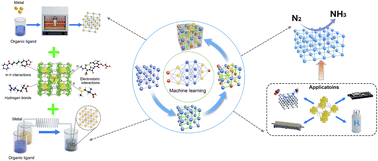
Metal–organic frameworks (MOFs) are highly versatile materials known for their exceptional properties, including high specific surface area, tunable pore structures, and multifunctionality, making them invaluable in fields of electrochemical ammonia synthesis. Over the past decade, MOF-based systems have evolved from initial N2-reduction prototypes into advanced catalysts that can convert nitrates and nitrites into ammonia. This offers a broader perspective on the electrochemical nitrogen cycle. However, their structural complexity poses significant challenges to traditional design and optimization approaches. This review first critically summarizes the recent advances in MOF development for electrochemical ammonia synthesis. Next, this review systematically explores the transformative role of machine learning (ML) in advancing MOF research. It also addresses the 8 major challenges and limitations currently facing this intersection, including data scarcity, model interpretability, and inverse design. To address these challenges and guide future progress, the review proposes 4 clear and practical future directions: leveraging explicable AI to improve model transparency, integrating active learning with automated platforms to optimize experimental workflows, exploring the synergy between ML and quantum computing to simulate complex structures, and fostering multidisciplinary collaboration for holistic innovation. By bridging computational intelligence and materials discovery, this work underscores the central role of ML in shaping the next generation of MOF-based technologies for sustainable energy and environmental applications.
- This article is part of the themed collection: ChemComm Electrocatalysis
 Please wait while we load your content...


