


 PLATFORM UPDATE:


Review of electrocatalysts in aqueous zinc–iodine batteries

Abstract
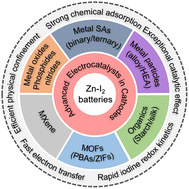
Aqueous zinc–iodine (Zn–I2) batteries exhibit exceptional safety and high electrochemical performance—in particular outstanding high-rate, long-cycle stability—making them promising alternatives to conventional alkali metal–based batteries. Unfortunately, Zn–I2 batteries face several critical challenges including the iodine species shuttling phenomenon and slow redox kinetics, which impede their real-life applications. The utilization of electrocatalysts with special electronic structures has been recognized as the ideal solution for resolving these issues. This review first describes the working mechanism of Zn–I2 batteries, then summarizes the reported electrocatalysts, and analyzes their design philosophies, structure construction strategies, and working principles. The underlying relationships between the detailed structures and catalytic capabilities of the electrocatalysts are clearly identified, and the electrochemical performances of various Zn–I2 systems are compared. Finally, the persisting obstacles are summarized, and potential solutions are elucidated. This work contributes to a thorough understanding of Zn–I2 batteries and provides guidance for the rational construction of advanced electrocatalysts.
 Please wait while we load your content...


