


 PLATFORM UPDATE:


Polymer-tethered glycosylated gold nanoparticles as versatile tools for bio-sensing
 *a
and
Matthew I.
Gibson
*ab
*a
and
Matthew I.
Gibson
*ab
Abstract
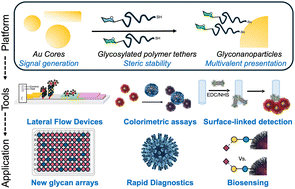
Glycans direct many biological recognition and signalling processes, spanning basic cell biology to diagnostics and therapy. Multivalent presentation of glycans is well established to increase avidity (but not always selectivity) and hence glycosylated (nano)materials have emerged as versatile scaffolds to probe glycobiological processes and for application in biomedicine. In this Feature article we review our laboratory's contributions to the development of polymer-tethered glycosylated gold nanoparticles. This approach exploits the steric stability of the polymer coating, ease of glycan capture and the plasmonic signal-generation of the gold core. The article covers the synthetic rationale for the polymeric tether, glycan capture modalities and application to screen (un)natural glycans binding patterns and translation into point-of-care lateral flow glyco-diagnostics and solution-phase colourimetric biosensors. We also suggest areas for future development and comparison to related systems.
 Please wait while we load your content...


