


 PLATFORM UPDATE:


Nonspherical polymer nano/micro particles: a guide to shape engineering
 *a
*a
Abstract
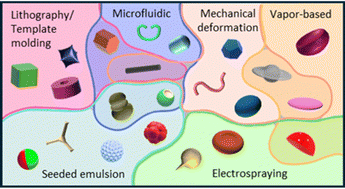
Polymer micro- and nanoparticles underpin applications from drug delivery to building materials, yet virtually all commercial grades of polymer particles are spherical, forfeiting the performance gains unlocked by shape engineering. In drug delivery, for instance, shape-engineered polymer particles promise longer circulation, targeted tissue penetration, programmable assembly, and tailored photonic responses, positioning geometry as an under-exploited design axis. Although three decades of lab-scale research have produced dozens of protocols for producing shaped polymer particles, a mechanism-centric roadmap that links fabrication route to attainable morphology has been missing. This review closes that gap by surveying more than 70 documented geometries and the physicochemical principles that create them. In brief, starting from the spherical polymer particles, mechanical deformation, such as film stretching, compression, and shear, reshapes spheres into rods, ellipsoids, discs, and polyhedra using low-cost tensile/compressive bench-top rigs. Increased complexity in particle shapes can be obtained via lithographic and template-molding platforms, yielding cuboids, prisms, rings, and sub-100 nm flakes with dimensional fidelity. By expanding upon the polymerization mechanism beyond photopolymerization, seeded emulsion polymerization exploits polymerization-induced phase separation to generate lobed, Janus, porous, and indented architectures while retaining a reasonable production throughput. Polymerization under shear, such as masked photopolymerization under continuous microfluidic confinement, cast plugs, prisms, high-curvature “hamburger” or “olive” motifs, and other extruded forms. Emerging template-free and confinement-free techniques, such as polymer plasticization, condensed-droplet polymerization, and electrospraying, expand the landscape to asymmetric shapes, leveraging interfacial tensions, condensation kinetics, and electric fields to sculpt morphology. Looking ahead, green chemistries and scalable process design constitutes critical steps that will unlock the societal impact of this emerging class of materials. This review aims to organize those disparate methods based on their fundamental mechanisms, thereby accelerating the design, synthesis, and production of shape-engineered soft materials, pointing to novel solutions in healthcare, consumer goods, structural materials, and active matter and robotics.
- This article is part of the themed collection: 2026 Pioneering Investigator Collection
 Please wait while we load your content...


