


 PLATFORM UPDATE:


Non-thermal plasma restructuring of electrocatalyst surfaces for efficient hydrogen and oxygen reactions

Abstract
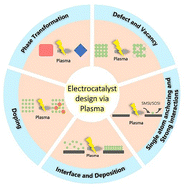
Electrocatalysts for water electrolysis, fuel cells, and metal–air batteries are largely governed by processes occurring within the outermost few nanometres of their surface. Low-temperature plasmas provide an effective means to tailor this region, using energetic electrons and reactive species to enable rapid, surface-confined modification while preserving the underlying scaffold. In this Feature Article, we review plasma engineering strategies for HER, OER and ORR electrocatalysts, including examples from zinc–air batteries and direct methanol fuel cells. We classify plasma effects into five generic design modes: phase transformation and plasma-assisted derivation; defect and vacancy engineering; plasma-induced doping; plasma-enabled deposition and interface construction; and single-atom anchoring with strong metal–support interactions. We also propose simple design rules that connect controllable plasma parameters to targeted active sites and device-level performance.
- This article is part of the themed collection: ChemComm Nanocatalysis
 Please wait while we load your content...


