


 PLATFORM UPDATE:

Theoretical insight into h-Fe7C3 catalyzed Fischer–Tropsch synthesis: unraveling the C2+ product formation mechanism and surface-specific electronic descriptors
Hui
Du  *b
*b
*b
Abstract
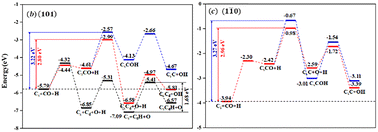
Iron-based Fischer–Tropsch synthesis (FTS) is key for carbon-neutral clean carbon utilization. With an elusive C–C coupling mechanism for C2+, surface hydrocarbon species coupling on h-Fe7C3 surfaces via a carbide and CO insertion mechanism was systematically investigated by DFT. The (101) and (1![[1 with combining macron]](https://www.rsc.org/images/entities/char_0031_0304.gif) ) surfaces possess the potential to form C2+ products. The reactant Mulliken charge as a primary descriptor correlates complicated surfaces and activities.
) surfaces possess the potential to form C2+ products. The reactant Mulliken charge as a primary descriptor correlates complicated surfaces and activities.
- This article is part of the themed collection: ChemComm Nanocatalysis
 Please wait while we load your content...


