Axial chlorine coordination reconstructs Fe–N4 electronic structure for efficient pH-universal oxygen reduction reaction

Abstract

Current Fe single-atom catalysts suffer from active-site blockage and aggregation. This study creates 2D nanosheet catalysts with axial chlorine-coordinated Fe–N4 sites (Fe–N4Cl) via molten salt-assisted pyrolysis. This configuration tunes the electronic structure, enhancing oxygen reduction. The catalyst outperforms Pt/C in alkaline, neutral, and acidic electrolytes, with half-wave potentials of 0.921 V, 0.742 V, and 0.771 V, respectively. In Zn–air batteries, it achieves a high power density of 176.5 mW cm−2 and stability over 720 hours, showing great potential for efficient energy conversion.
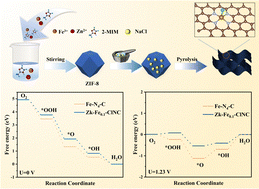
Graphical abstract: Axial chlorine coordination reconstructs Fe–N4 electronic structure for efficient pH-universal oxygen reduction reaction

Supplementary files

Article information

Article type
Communication
Submitted
27 Nov 2025
Accepted
08 Dec 2025
First published
16 Dec 2025

Chem. Commun., 2026, Advance Article

Axial chlorine coordination reconstructs Fe–N4 electronic structure for efficient pH-universal oxygen reduction reaction

Y. Yuan, X. Zhang, F. Qin, C. Lei, Y. Wang, Y. Yang, G. Feng, K. Liu and T. Chen, Chem. Commun., 2026, Advance Article , DOI: 10.1039/D5CC06734K

To request permission to reproduce material from this article, please go to the Copyright Clearance Center request page.

If you are an author contributing to an RSC publication, you do not need to request permission provided correct acknowledgement is given.

If you are the author of this article, you do not need to request permission to reproduce figures and diagrams provided correct acknowledgement is given. If you want to reproduce the whole article in a third-party publication (excluding your thesis/dissertation for which permission is not required) please go to the Copyright Clearance Center request page.

Read more about how to correctly acknowledge RSC content.

Social activity

Spotlight

Advertisements