Harnessing 4f-3d synergy in Ce-Fe heterostructure: a PBA-derived oxygen reservoir for stable high-capacity lithium storage
Abstract
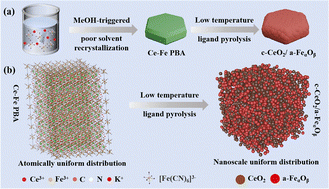
Transition metal oxide (TMO) anodes face a critical trade-off between anionic redox capacity and structural stability, leading to irreversible oxygen loss and rapid capacity decay. Herein, we introduce a MOF-derived c-CeO2/a-FeαOβ heterostructure synthesized via atomic-scale dispersion of Ce-Fe Prussian blue analogues and controlled pyrolysis, integrating crystalline CeO2 nanocrystals within an amorphous FeαOβ matrix. This design leverages strong Ce-Fe electronic coupling via 4f-3d orbital hybridization to orchestrate three synergistic mechanisms: Dynamic oxygen stabilization through reversible Ce3+/Ce4+-Fe2+/Fe3+ cycling; Strain-minimized Fe redox enabled by interfacial charge redistribution; and Accelerated Li+ transport via coupled electron-ion pathways. The orbital overlap enables bidirectional electron transfer, suppressing excessive oxygen vacancies and irreversible oxygen release. Simultaneously, it modulates Fe’s electronic environment to reduce lattice strain during redox transitions while constructing a continuous conductive network that lowers charge-transfer resistance and widens Li+ diffusion channels. The heterostructure achieves a high reversible capacity of 1791 mAh g-1 at 1 A g-1 and at a higher current density of 5 A g-1, it retains 829 mAh g-1 after 2600 cycles with 99.94% Coulombic efficiency, outperforming state-of-the-art iron-based anodes. This work demonstrates the synergy of lanthanide orbital engineering and atomic-level heterointerface design for high-capacity, stable battery anodes.
Please wait while we load your content...