Terephthalic Acid Intercalation Strengthens NiFe-Layered Double Hydroxide for Durable and Efficient Seawater Electrolysis

Abstract

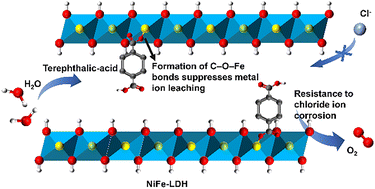
Developing oxygen evolution catalysts that couple high activity with robust corrosion resistance is essential for sustainable hydrogen production from seawater. Here, we report a molecular intercalation strategy to stabilize nickel–iron layered double hydroxides (NiFe-LDHs) by incorporating terephthalic acid (TPA) via a one-step electrodeposition route. The resulting NiFe-LDH(TPA) features a nanoflower morphology with enlarged interlayer spacing and strong C–O–Fe coordination, which jointly optimize electronic structure and suppress metal dissolution. Consequently, NiFe-LDH(TPA) requires only 216 mV to deliver 10 mA cm-2 with a Tafel slope of 59 mV dec-1 in 1 M KOH seawater, outperforming RuO2. Remarkably, the catalyst maintains activity for over 700 h at 500 mA cm-2 with negligible degradation. Operando Raman spectroscopy reveals that TPA intercalation facilitates the Ni2+/Ni3+ transition toward active NiOOH species at lower potentials while mitigating Cl--induced corrosion. This work introduces organic molecular intercalation as an effective route to engineer robust LDH-based anodes for direct seawater electrolysis.

Supplementary files

Article information

Article type
Communication
Submitted
01 Dec 2025
Accepted
08 Jan 2026
First published
09 Jan 2026

Chem. Commun., 2026, Accepted Manuscript

Terephthalic Acid Intercalation Strengthens NiFe-Layered Double Hydroxide for Durable and Efficient Seawater Electrolysis

X. Li, Y. Zhu, Y. Huang, Y. Cai, K. Liu, L. Wang, Z. Wang, D. L. Zhu and D. Liu, Chem. Commun., 2026, Accepted Manuscript , DOI: 10.1039/D5CC06658A

To request permission to reproduce material from this article, please go to the Copyright Clearance Center request page.

If you are an author contributing to an RSC publication, you do not need to request permission provided correct acknowledgement is given.

If you are the author of this article, you do not need to request permission to reproduce figures and diagrams provided correct acknowledgement is given. If you want to reproduce the whole article in a third-party publication (excluding your thesis/dissertation for which permission is not required) please go to the Copyright Clearance Center request page.

Read more about how to correctly acknowledge RSC content.

Social activity

Spotlight

Advertisements