Recent developments in antimicrobial polymers for biofilm inhibition

Abstract

Biofilm-associated infections continue to present a formidable clinical challenge, as surface-adhered microbial communities exhibit remarkable tolerance toward conventional antibiotics. Polymeric materials have emerged as a versatile platform for combating biofilms, offering chemical tunability and enabling diverse antimicrobial strategies. This feature review article highlights recent advances in polymeric materials designed to prevent biofilm-associated infections by resisting bacterial adhesion (passive inhibition) or exerting bactericidal effects (active inhibition). These approaches include antifouling surfaces, polymer–nanoparticle composites, and bioinspired materials. Particular attention is given to how polymer structure and functionality (e.g., hydrophobicity, charge, and network architecture) govern bacterial adhesion and viability at interfaces. Emerging glycomaterials are also discussed, where glycan motifs are integrated with nanoparticles or cationic domains to enhance biofilm penetration and antimicrobial efficacy. Collectively, these studies underscore the potential of polymeric materials to modulate microbe–surface interactions, thereby guiding the design of next-generation antibiofilm materials.
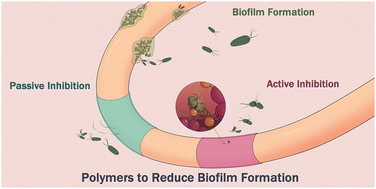
Graphical abstract: Recent developments in antimicrobial polymers for biofilm inhibition

Article information

Article type
Feature Article
Submitted
20 Nov 2025
Accepted
05 Mar 2026
First published
26 Mar 2026
This article is Open Access
Creative Commons BY-NC license

Chem. Commun., 2026, Advance Article

Recent developments in antimicrobial polymers for biofilm inhibition

G. A. Kropp, C. N. McMillian, J. D. Mase, S. Kandagiri, E. S. Nowak and M. D. Schulz, Chem. Commun., 2026, Advance Article , DOI: 10.1039/D5CC06617D

This article is licensed under a Creative Commons Attribution-NonCommercial 3.0 Unported Licence. You can use material from this article in other publications, without requesting further permission from the RSC, provided that the correct acknowledgement is given and it is not used for commercial purposes.

To request permission to reproduce material from this article in a commercial publication, please go to the Copyright Clearance Center request page.

If you are an author contributing to an RSC publication, you do not need to request permission provided correct acknowledgement is given.

If you are the author of this article, you do not need to request permission to reproduce figures and diagrams provided correct acknowledgement is given. If you want to reproduce the whole article in a third-party commercial publication (excluding your thesis/dissertation for which permission is not required) please go to the Copyright Clearance Center request page.

Read more about how to correctly acknowledge RSC content.

Social activity

Spotlight

Advertisements