


 PLATFORM UPDATE:


Zn metal-free zinc ion hybrid supercapacitors: principles, innovations, and future directions

Abstract
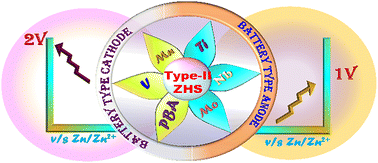
In the last few years, zinc ion hybrid supercapacitors (ZHSs), comprising a capacitive-type cathode coupled with zinc foil as the anode, have attracted considerable attention for modern electrochemical applications due to their high theoretical capacity, reliability, and environmental friendliness. However, these ZHSs face substantial challenges owing to dendrite formation, hydrogen evolution, corrosion, and other passive reactions of Zn metal, posing significant obstacles to their practical feasibility. In this regard, Zn metal-free Type-II ZHSs offer a compelling alternative and are increasingly studied to resolve these intrinsic challenges. However, comprehensive review articles focused on their construction and the selection of related electrode materials, which are essential for the fabrication of Zn metal-free Type-II ZHSs, remain very scarce. Therefore, this article provides a comprehensive review of the historical developments in ZHSs, their fundamentals, and the limitations of Type-I ZHSs. Subsequently, an overview of recent progress in battery-type cathode (Mn-based, V-based, PBA, and others) and anode materials (Nb-based, Mo-based, TiS2, TiSe2, and others) investigated for Type-II Zn metal-free hybrid supercapacitors is provided. Finally, the advantages, key bottlenecks, and viewpoints are highlighted to facilitate the future progress of Type-II ZHSs. It is anticipated that this review article will provide strategic guidance, with a primary focus on the design and development of high-performance Zn metal-free ZHSs, complementing the existing Type-I ZHSs.
 Please wait while we load your content...


