Polymerization-Induced fluoroacetonitrile-based heterogeneous lithium metal batteries
Abstract
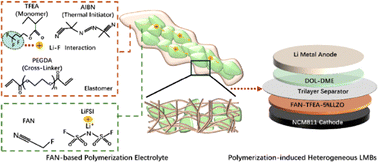
We report a polymerization-induced heterogeneous configuration (PIHC) that spatially confines a crosslinked fluoroacetonitrile (FAN)based electrolyte at the cathode and a conventional ether electrolyte at the anode, effectively suppressing detrimental shuttling. The electrolyte retains ultrahigh ionic conductivities of 29.6 mS cm -1 at 25 o C and 4.44 mS cm -1 at -70 °C.State-of-the-art lithium metal batteries (LMBs) predominantly rely on ether-based electrolytes to facilitate efficient lithium plating/stripping and extend cycle life. Nevertheless, these systems often present an inherent trade-off between electrochemical performance and intrinsic electrolyte stability. 1,2 Specifically, ether solvents exhibit limited oxidative stability and high volatility, which severely hinders their implementation in high-energy-density LMBs paired with highvoltage, high-nickel NCM cathodes. In contrast, carbonate electrolytes, the mainstay of commercial lithium-ion batteries (LIBs), offer superior oxidation resistance, lower volatility, and enhanced thermal stability. Their utility, however, has been historically limited by poor compatibility with lithium-metal anodes, leading to continuous parasitic reactions. 3,4 Consequently, recent research focuses on formulating electrolytes that simultaneously ensure high lithium-metal compatibility (enabling a stable SEI), robust oxidative stability, and rapid ion transport. Promising strategies include highconcentration electrolytes, 5,6 localized high-concentration electrolytes, 7,8 and weakly solvating electrolytes 9,10 A common
Please wait while we load your content...