Highly stable self-assembled nanotubes from a bipyridinium-based amphiphilic pseudopeptide

Abstract

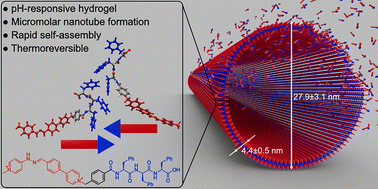
Herein, we report an amphiphilic pseudopeptide that spontaneously self-assembles into monodisperse cationic nanotubes under physiological conditions. These nanotubes exhibit fast self-assembly, remarkable thermal stability and thermoreversibility. The self-assembly concentration range is exceptionally broad, enabling the formation of stable hydrogels at concentrations above 5 mM while preserving the nanostructure at micromolar levels.
Supplementary files

Transparent peer review

To support increased transparency, we offer authors the option to publish the peer review history alongside their article.

View this article’s peer review history

Article information

Article type
Communication
Submitted
30 Oct 2025
Accepted
22 Dec 2025
First published
23 Dec 2025
This article is Open Access
Creative Commons BY license

Chem. Commun., 2026, Accepted Manuscript

Highly stable self-assembled nanotubes from a bipyridinium-based amphiphilic pseudopeptide

A. Vila, V. Gauci and A. Blanco-Gómez, Chem. Commun., 2026, Accepted Manuscript , DOI: 10.1039/D5CC06185G

This article is licensed under a Creative Commons Attribution 3.0 Unported Licence. You can use material from this article in other publications without requesting further permissions from the RSC, provided that the correct acknowledgement is given.

Read more about how to correctly acknowledge RSC content.

Social activity

Spotlight

Advertisements