


 PLATFORM UPDATE:


Demystifying hydrogen evolution: the role of advanced functional materials in powering breakthroughs
 *a
*a
Abstract
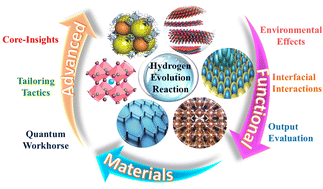
In the current landscape, the world is grappling with mounting environmental crises and a persistent fossil fuel crunch. Thus, a bold shift toward sustainable, carbon-neutral renewable energy systems with advanced storage and conversion capabilities is crucial to tackle these urgent challenges head-on. In this context, hydrogen (H2), with its unmatched gravimetric energy density, stands out as the ultimate clean energy carrier, leaving minimal ecological footprint due to its zero harmful emissions. However, the practical realization of H2 technologies is hindered by the lack of rational guidelines for designing catalysts that are simultaneously highly active, durable, and cost-effective at industrial scales. It is thus of paramount importance to design materials that combine high activity, long-term durability, and cost-effectiveness to drive the successful adoption of hydrogen-based energy technologies. This review delves into the core-principles of overall water splitting, unravelling its kinetics, the influence of reaction conditions and analysis of metrics involved in performance assessment together with the pivotal role of density functional theory (DFT) and enthalpic contributions in pushing the boundaries of theoretical modelling and tuning of surface energetics, which thereby optimize the H2 adsorption–desorption dynamics. We also offer actionable, application-focused strategies for designing and selecting industrial-grade HER catalysts and spotlight the fabrication strategies fuelling material innovation, alongside the performance and sustainability of cutting-edge functional materials aimed at sparking further research in this transformative field and advancing the collective mission of safeguarding our planet and its pulse.
- This article is part of the themed collection: ChemComm Electrocatalysis
 Please wait while we load your content...


