


 PLATFORM UPDATE:


Organic photovoltaic microburritos for photo(electro)catalytic peroxide generation

Abstract
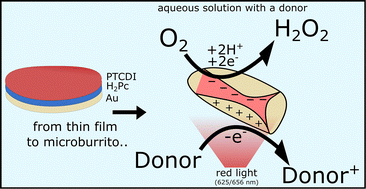
We present organic semiconductor “microburritos” as a scalable microdevice for spatiotemporally precise hydrogen peroxide generation for in vitro biological experiments. By integrating an organic donor–acceptor heterojunction with gold, these devices harness light to drive oxygen reduction while simultaneously mediating oxidation of donor molecules in the surrounding medium. We critically compare peroxide generation in different media and characterize the effects of illumination pulsing frequency on peroxide accumulation and the side effect of photothermal heating. The result of our effort is both the establishment of a reliable, light-responsive microdevice and a contribution to understanding the semiconductor-mediated redox cycle, paving the way for advanced bioelectronic and photo(electro)catalytic applications.
 Please wait while we load your content...


