


 PLATFORM UPDATE:

Single-atom catalysts for selective electrochemical CO2 reduction to C2 products
 a
and
Zhichuan J.
Xu
*a
a
and
Zhichuan J.
Xu
*a
Abstract
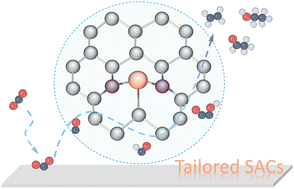
Conversion of CO2 into useful products offers promising pathways towards achieving global carbon neutrality, and the development of corresponding advanced catalysts is important but challenging. Many catalysts can facilitate the conversion of CO2 into mono-carbon C1 products (such as carbon monoxide and formic acid), while conversion of CO2 into high-value-added multi-carbon compounds (such as ethylene and ethanol) requires multiple proton-coupled-electron-transfer (PCET) steps and targeted control product selectivity, which remain difficult to achieve in most catalysts. Single atom catalysts (SACs) demonstrate great potential for efficiently electrolyzing CO2 molecules into high valued chemicals with striking features, including atomically dispersed metal centres, well defined coordination environments, and tuneable electronic structures. In this review, the latest advances in SACs for CO2 conversion are comprehensively summarized, highlighting how SACs design influences product selectivity in CO2 reduction reactions, particularly for challenging C2 products with higher volumetric energy densities and market value. The fundamentals of SACs are first introduced, highlighting their unique advantages and outlining state-of-the-art design strategies and modification methods for performance optimization. The catalytic mechanism of CO2 on SACs is then delved into and their inspiration for SACs design is elucidated. Most importantly, the latest representative examples of engineered SACs for the electrochemical CO2 reduction reaction and design principles are presented and how novel SACs engineering enhances their activity, selectivity and stability is discussed, providing guidance for the development of efficient and durable SACs. Finally, the current challenges and limitations in this field are identified and future research opportunities are proposed, suggesting concepts for creating durable and highly active catalytic platforms for CO2 conversion and further applications.
 Please wait while we load your content...


