


 PLATFORM UPDATE:


Recent advances in hydrogel polymer electrolytes for stable zinc metal anodes
 a
and
Jiaqian
Qin
*c
a
and
Jiaqian
Qin
*c
Abstract
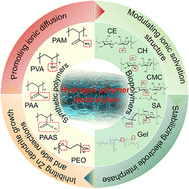
Aqueous Zn-ion batteries (AZIBs) represent a promising class of electrochemical energy storage devices, leveraging the natural abundance, low cost and high theoretical capacity of Zn, along with the inherent safety and environmental benefits of aqueous electrolytes. Nevertheless, the widespread commercialization of these systems is impeded by significant challenges, including uncontrolled Zn dendrite growth, hydrogen evolution, corrosion and interfacial instability, which collectively degrade cycling performance and operational longevity. In response, use of hydrogel polymer electrolytes has emerged as a highly effective material strategy to regulate ion transport, modify interfacial electrochemistry and enhance structural stability. This review comprehensively summarizes recent advancements in the rational design of functional hydrogel electrolytes for high-performance Zn anodes, with a focus on the roles of polymer network architectures, functional group engineering and hybrid electrolyte formulations in guiding uniform Zn deposition and suppressing parasitic reactions. Furthermore, the interplay between polymer matrix properties, solvation structure modulation and ion-transport dynamics is critically discussed. Finally, we provide insightful perspectives on future research directions aimed at overcoming existing limitations and accelerating the development of reliable and energy-dense AZIBs.
 Please wait while we load your content...


