


 PLATFORM UPDATE:


Selective singlet oxygen generation by microporous biochar for peracetic acid activation
Shaobin
Wang  a
and
Wenjie
Tian
*a
a
and
Wenjie
Tian
*a
a
and
Wenjie
Tian
*a
Abstract
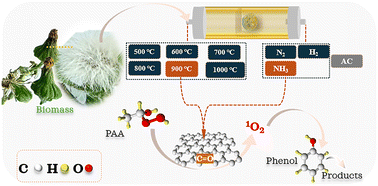
This study shows that the pyrolysis temperature and atmosphere critically affect the physiochemical properties of biochar. NH3-assisted pyrolysis at 900 °C produces biochar (NH3-C-900) with superior activity for peracetic acid activation, selectively generating singlet oxygen for rapid phenol degradation. Micropores contribute positively to the catalytic performance, with C![[double bond, length as m-dash]](https://www.rsc.org/images/entities/char_e001.gif) O groups serving as the key active sites, while C–O and COOH are unfavorable.
O groups serving as the key active sites, while C–O and COOH are unfavorable.
- This article is part of the themed collection: 2026 Emerging Investigator Collection
 Please wait while we load your content...


