


 PLATFORM UPDATE:


Excited-state intramolecular proton transfer (ESIPT) based metal–organic frameworks for smart sensing and stimuli-responsive applications

Abstract
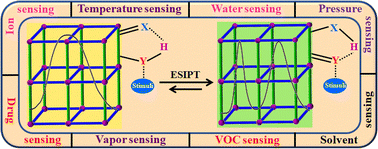
Excited-state intramolecular proton transfer (ESIPT)-based sensing applications have emerged as a powerful and distinctive strategy for the detection of various analytes, offering matchless advantages over traditional sensing techniques. The ESIPT process is characterized by its ultrafast tautomerization, associated with broad tunability, and large Stokes shifts in fluorescence emission. This is highly desirable for qualitative and quantitative detection, especially in complex environments, viz. reaction intermediates, industrial waste monitoring, fuel purity etc. Several ESIPT-active organic compounds have been reported, but the development of ESIPT-based metal–organic frameworks (MOFs) is still at a rudimentary stage, as the challenge lies in the design, especially in terms of dual-emissive behavior, which is a signature of ESIPT-based effective sensing. This unique characteristic of the ESIPT process is due to the stringent requirement of a narrow energy gap between two tautomeric forms. Incorporating specially designed ESIPT-based organic linkers in MOFs, with their stable and tunable structures, offers a promising platform to realize the distinctive ESIPT-driven dual-emissive behavior. This review article highlights our persistent effort to understand the ESIPT behaviour in MOFs, along with related reports from other groups. In this way, we have tried to articulate our understanding towards the structure–property relationships in ESIPT active MOFs. The effects of external stimuli, such as pressure, temperature, pH, light, solvent polarity, and ionic species, in modulating ESIPT in MOFs have also been taken into consideration for their advanced applications.
 Please wait while we load your content...


