


 PLATFORM UPDATE:


Design of covalent organic frameworks (COFs) for photocatalytic CO2 reduction under metal-free conditions

Abstract
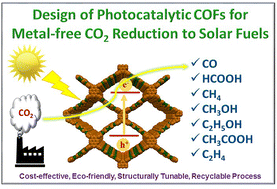
The photoreduction of carbon dioxide (CO2) into solar fuels necessitates efficient photocatalysts to overcome the energy barrier for effective CO2RR. Consequently, the photocatalyst must possess an appropriate band gap and optimal CO2 reduction potential, and facilitate efficient charge separation and migration. In this context, covalent organic frameworks (COFs) show immense potential as efficient photocatalysts for light-driven CO2 transformation and have been extensively studied. In this feature article, we review recent developments in COF-based photocatalysts for CO2 reduction into solar fuels under metal-free conditions. First, we briefly discuss the fundamental aspects of photocatalytic CO2 reduction, focusing on the basic principles, mechanisms, and energetic requirements for photocatalytic conversion. Additionally, we describe the structural and optoelectronic properties of COFs, particularly their crystallinity, porosity, stability, bandgap engineering, charge transport, and CO2 reduction capability. Various synthetic strategies for COFs have also been developed to design stable and efficient COF-based photocatalysts. Furthermore, the recent progress of metal-free COF-based photocatalysts for light-driven carbon dioxide reduction reaction (CO2RR) is covered. The challenges in developing greener, safer, and eco-friendly COFs as photocatalysts have been discussed. At the end, a summary of the advancements in COFs as photocatalysts, outlining the challenges and future perspectives for effective CO2RR to solar fuels, is highlighted.
 Please wait while we load your content...


