


 PLATFORM UPDATE:


Pharmacology of estrogen-related receptors (ERRs) agonists
 *ab
*ab
Abstract
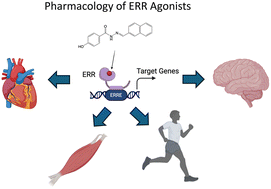
The estrogen-related receptors (ERRs) are a subfamily of orphan nuclear receptors that share high structural homology with classical estrogen receptors but do not bind endogenous estrogens. The three isoforms – ERRα, ERRβ, and ERRγ – exhibit constitutive transcriptional activity and regulate genes involved in mitochondrial biogenesis, oxidative metabolism, and energy homeostasis. ERRα and ERRγ are highly expressed in metabolically active tissues, including the heart, skeletal muscle, and liver, where they play central roles in metabolic adaptation and muscle function. Pharmacological activation of ERRα and ERRγ has therefore emerged as a promising strategy for the treatment of metabolic and muscle-related disorders as well as conditions where mitochondrial function decreases such as aging. This review focuses on the pharmacology of ERRs, their agonists, and the medicinal chemistry strategies underlying their development. Agonists are classified according to chemotype, and the structure–activity relationships (SAR) of each scaffold are analyzed, highlighting key pharmacological strengths and limitations. The chemotypes discussed include acyl hydrazones, 2,5-disubstituted thiophenes, pyrido[1,2-α]pyrimidin-4-ones, 1,2,3-triazoles, bisphenols, and amide-based agonists. Collectively, this work provides a comprehensive framework to guide the rational design of next generation ERRs agonists with improved pharmacological and translational potential.
 Please wait while we load your content...


