


 PLATFORM UPDATE:

Post-translational modifications of silk proteins
 *ab
*ab
Abstract
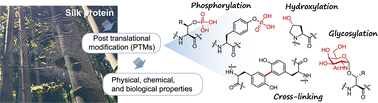
Post-translational modifications (PTMs) endow silk proteins with chemical diversity that governs their higher-order assembly, hydration, and covalent connectivity. This review highlights the principal PTMs that define silk protein function, including hydroxylation, glycosylation, phosphorylation, and covalent crosslinking. We also describe their contributions to protein structural stability and mechanical properties. Recent advances in proteomics have begun to reveal low-abundance PTMs, whereas synthetic biology and bioorthogonal chemistry enable the programmed installation of modifications to tune physicochemical properties. Understanding and harnessing these chemistries provides a foundation for the predictive design of next-generation protein-based materials at the interface of chemical biology and materials science.
 Please wait while we load your content...


