Illuminating microtubule functions with small molecules: past, present and future of fluorescent tubulin-binding probes

Abstract

Developing tools for the real-time visualization of tubulin, microtubules, and their dynamics is essential for studying key cellular processes such as cell division, migration, and differentiation. In this context, fluorescent small-molecule probes that bind to distinct and specific sites on microtubules have significantly advanced our understanding of tubulin dynamics and functions. In addition, fluorescent probes targeting tubulin have enabled the development of high-throughput screening assays to identify novel anti-tubulin compounds. In this review, we present a comprehensive overview of currently available fluorescent molecules that bind to tubulin, detailing their chemical structures, binding sites, development strategies and relevance to the study of microtubule functions. We also explore future directions in this field and highlight key fluorescent probes that are still lacking. Developing these tools would enable the investigation of tubulin's diverse cellular roles in even greater depth and support the advancement of tubulin-targeted therapeutics.
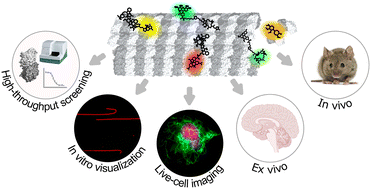
Graphical abstract: Illuminating microtubule functions with small molecules: past, present and future of fluorescent tubulin-binding probes

Transparent peer review

To support increased transparency, we offer authors the option to publish the peer review history alongside their article.

View this article’s peer review history

Article information

Article type
Review Article
Submitted
11 Dec 2025
Accepted
04 Feb 2026
First published
11 Feb 2026
This article is Open Access
Creative Commons BY-NC license

RSC Chem. Biol., 2026, Advance Article

Illuminating microtubule functions with small molecules: past, present and future of fluorescent tubulin-binding probes

R. París-Ogáyar, D. Lucena-Agell, K.-H. Altmann, V. Palomo and J. F. Díaz, RSC Chem. Biol., 2026, Advance Article , DOI: 10.1039/D5CB00321K

This article is licensed under a Creative Commons Attribution-NonCommercial 3.0 Unported Licence. You can use material from this article in other publications, without requesting further permission from the RSC, provided that the correct acknowledgement is given and it is not used for commercial purposes.

To request permission to reproduce material from this article in a commercial publication, please go to the Copyright Clearance Center request page.

If you are an author contributing to an RSC publication, you do not need to request permission provided correct acknowledgement is given.

If you are the author of this article, you do not need to request permission to reproduce figures and diagrams provided correct acknowledgement is given. If you want to reproduce the whole article in a third-party commercial publication (excluding your thesis/dissertation for which permission is not required) please go to the Copyright Clearance Center request page.

Read more about how to correctly acknowledge RSC content.

Social activity

Spotlight

Advertisements