


 PLATFORM UPDATE:


Red-shifted d-luciferin analogues and their bioluminescence characteristics
 a
Narin
Lawan,
b
Ryo
Nishihara,
g
Kazuki
Niwa,
h
Yoshihiro
Nakajima,
c
Pimchai
Chaiyen
*a
a
Narin
Lawan,
b
Ryo
Nishihara,
g
Kazuki
Niwa,
h
Yoshihiro
Nakajima,
c
Pimchai
Chaiyen
*a
Abstract
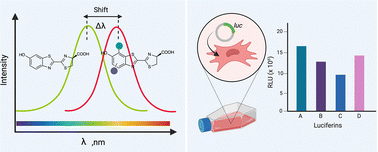
D-Luciferin (D-LH2) is the most used substrate for beetle luciferases in various bioluminescence applications. Here, we successfully synthesized six D-LH2 analogues including 5′,7′-dimethoxy-D-LH2 and 7′-methylnaphthol-D-LH2 as novel compounds. We also developed a continuous one-pot green synthesis method to improve yields of luciferins from condensation of quinone and D-Cys (63-fold greater than the previous report). The novel D-LH2 analogues were tested with five luciferases (Fluc, SLR, Eluc, Pmluc-WT, and Pmluc-N230S), and all the compounds emitted bioluminescence at wavelengths longer than that of D-LH2 (>80 nm). The reaction of SLR with 5′,7′-dimethoxy-D-LH2 gave the longest red-shifted bioluminescence at 663 nm. Remarkably, the reactions of 5′-methyl-D-LH2 emit longer wavelengths and brighter light than those of D-LH2 in all tested luciferases, except for Eluc. Interestingly, the novel red-shifted 5′,7′-dimethyl-D-LH2 also provided prolonged bioluminescence with a rate of light decay slower than that of D-LH2. We further demonstrated applications of 5′-methyl-D-LH2 and 5′,7′-dimethyl-D-LH2 in mammalian cell lines expressing Fluc, SLR, and Pmluc-N230S. 5′-Methyl-D-LH2 provided about 11.2-fold greater sensitivity to detect Fluc in the HEK293T crude lysate than D-LH2, achieving the detection with a lower number of cell lines. The red-shifted 5′,7′-dimethyl-D-LH2 also exhibits high sensitivity when using a red light filter to monitor live cell bioluminescence. These D-LH2 analogues, 5′-methyl-D-LH2 and 5′,7′-dimethyl-D-LH2, are promising substrates for future cell-based assays and real-time monitoring applications.
- This article is part of the themed collection: Celebrating International Women’s day 2026: Women in Chemical Biology
 Please wait while we load your content...


