


 PLATFORM UPDATE:

Structure and characterisation of CMP-Kdn synthetase from the haptophyte microalgae Prymnesium parvum
 a
Robert A.
Field
*abc
a
Robert A.
Field
*abc
Abstract
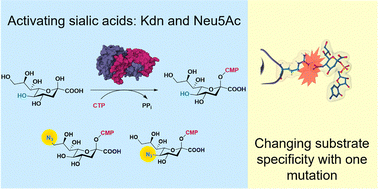
Sialic acids – 9-carbon ulosonic acids – are implicated in many cell–cell and host–pathogen interactions due to their prevalent location at the non-reducing end of glycoconjugates. Sialic acids have recently been observed in microalgae, including the toxic bloom-forming Prymnesium parvum, which produces the deaminated sialic acid, ketodeoxynonulosonic acid (Kdn), through de novo biosynthesis. Here we report on the key CMP-sialic acid synthetase enzyme (CMAS), PpNeuA, which activates Kdn to its sugar nucleotide congener, CMP-Kdn. In the present study, the X-ray crystal structure of PpNeuA was determined to 1.8 Å resolution and shows that it adopts a similar overall fold to that of other sialic acid synthetase enzymes, with which it shares ca 30% amino acid sequence identity. PpNeuA specificity for Kdn is dependent upon Arg196, a hydrophilic residue that is only found in Kdn-specific sialic acid synthetases. R196L mutation switches the substrate preference of PpNeuA from Kdn to N-acetylneuraminic acid (Neu5Ac). Kinetic analysis shows that Arg196 plays both a role in substrate binding (impact on KM) and catalysis (impact on kcat). In the context of generating metabolic probes to identify the location and context (glycolipid vs glycoprotein) of Kdn in P. parvum, we also report on the ability of PpNeuA to accept both 5Az-Kdn and 9Az-Kdn as substrates.
 Please wait while we load your content...


