


 PLATFORM UPDATE:


Programmable synthesis of alkaloidal frameworks integrating Michael acceptor generates covalent probes for targeting POLE3 in HBV replication
 a
Haruki
Mizoguchi,
e
Masaya
Sugiyama,
g
Naoshi
Dohmae,
*f
Hiroyuki
Osada,
f
Hiroki
Oguri
*a
a
Haruki
Mizoguchi,
e
Masaya
Sugiyama,
g
Naoshi
Dohmae,
*f
Hiroyuki
Osada,
f
Hiroki
Oguri
*a
Abstract
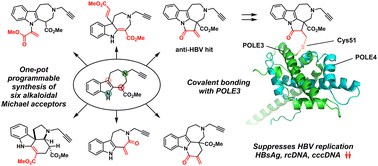
The growing need for effective HBV treatments and lead compounds with novel mechanisms prompted us to explore synthetic strategies for generating skeletally diverse alkaloidal Michael acceptors. Our approach uniquely embeds Michael acceptors directly within multicyclic alkaloid-inspired frameworks, exploiting the azepinoindole scaffold—a privileged structure in indole alkaloids. A single-step assembly between the versatile intermediate 13 with methyl propiolate 14 or its derivatives enabled the rapid and divergent synthesis of six alkaloidal Michael acceptors (15–20). This strategy facilitated systematic diversification of three-dimensional functional group arrangements and precise tuning of the electronic and steric properties of the embedded α,β-unsaturated carbonyl moieties. The optimal hit 15 inhibited hepatitis B surface antigen (HBsAg) production with an IC50 of 2.48 μM and significantly reduced levels of covalently closed circular DNA (cccDNA), the master template of HBV. Unlike existing nucleoside/nucleotide-based anti-HBV drugs that primarily inhibit reverse transcription, the alkaloidal Michael acceptor 15 suppressed both cccDNA and relaxed circular DNA (rcDNA) levels, suggesting a potential pathway toward a functional HBV cure. Our study also streamlined the target identification by leveraging the covalent binding properties of the Michael acceptors and the operational simplicity of biotin- or fluorescent-tag attachment via a pre-installed alkyne moiety. Competitive pull-down experiments identified several potential target proteins, involving DNA polymerase epsilon subunit 3 (POLE3). Notably, the alkaloidal Michael acceptor 15 was demonstrated to covalently modify Cys51 in POLE3, providing new insights into virus–host interactions and opening novel avenues for targeted anti-HBV therapies. This approach represents a significant advance beyond traditional screening methods and underscores the potential of skeletally diverse alkaloidal Michael acceptors in antiviral drug development.
 Please wait while we load your content...


